How to Invest When You're Tired of Inflation
Don't let time erode the value of your money. We show you how to invest simply in physical gold to protect the purchasing power of your savings.
Goldtresor Team
· 6 min read
Don't let time erode the value of your money: we show you how to invest simply in physical gold to protect the purchasing power of your savings.
Despite inflation having returned, your bank still pays no meaningful interest on your current account balance — to say nothing of the value erosion suffered by cash kept under the mattress.
What is more, government bond yields have now shrunk to single digits, while it is becoming increasingly clear that we stand on the threshold of an inflationary decade not seen for forty years.
You may rightly ask yourself whether it is worth running the risk of monetary devaluation and financial system collapse when you are not even compensated for it in nominal terms.
Why Is It Better to Hold Gold Than Cash or a Bank Account?
Perhaps the most important argument in favour of investing in gold is that it genuinely preserves its value over the long term.
For this reason, it is definitely worth investing that portion of funds sitting idle in your current account or held as cash at home that you are unlikely to need over the next few years.
It is true that gold pays no interest — but in return, it protects the value of your wealth precisely when economic or wider global conditions are at their most difficult.
Gold carries no counterparty risk, unlike banks or securities.
This is why the yellow metal tends to appreciate sharply whenever confidence in the global financial system is shaken — its value does not depend on the solvency of states, banks or corporations.
Read our post below if you would like to learn more about why it makes sense to hold part of your money in gold.
How Much Does a Gold Investment Return?
The dollar price of gold has risen on average by 8-9% per year since 1971, with significantly larger gains during periods of crisis, while the average US inflation rate has been 3.9%:
It is also evident that gold prices decline once calm returns, which makes the timing of gold investment important.
The best approach is to become a considered gold investor.
Since we are in Hungary, where the currency — and the primary savings vehicle — is the forint, it is worth taking a look at the long-term gold price chart in forint terms:
Striking as it may seem, this is not a bitcoin chart — it is a vivid demonstration that since its introduction, the forint has lost 99.95% of its purchasing power relative to gold.
Fair enough, but wages have also risen since then, haven't they? — you might rightly ask.
Well, let us examine, based on KSH data, how long it would have taken to save up for one kilogram of gold in 1960 versus 2023, assuming we spent nothing on anything else — no food, no drink, no parties, no street food, no campfire evenings — and instead set aside our entire salary in order to buy 1 kg of gold.
In 1960, it would have taken less than one year to save up for 1 kg of gold from the average wage — precisely 8.38 months. "Would have taken", because the system at the time deliberately prohibited gold investment.
By contrast, today it takes 47.26 months — nearly four years — of hard work to save up for that same 1 kg of gold. That figure is based on gross wages; calculated on today's net wages (in 1960, workers received their full salary in hand) it would take 68.70 months — five and three-quarter years — to save up for a one-kilogram gold bar.
How Do You Start Investing in Gold?
There are essentially four options for investing in gold:
- Jewellery purchases
- Paper gold investment
- Investment gold purchases
- Opening a physically backed gold account
Jewellery Purchases
There are two main problems with buying jewellery for investment purposes.
First, on top of the gold price you must pay at least 20-50% in fabrication costs, plus 27% VAT. For highly prestigious jewellery brands, fabrication costs can reach 500%.
Second — and this is the greater problem — without a fire assay (smelting), only an approximate assessment of the actual gold content of a purchased item is possible, so extreme care is required and purchases should be made exclusively from very reputable operators.
For this reason, if you buy gold jewellery, treat it as a luxury expenditure or a gift purchase rather than an investment.
Paper Gold Investment
Professional investors experienced in exchange-traded products, and managers of private banking wealth, most often choose paper gold — that is, exchange-traded gold investment funds, or futures or leveraged instruments — since trading costs are negligible.
As these are financial products, they are suitable solely for price speculation, since you still bear the risk of the banking intermediary system. In a truly severe crash, you would not receive the gold owed to you even from physically backed investment funds — let alone from various purely paper-backed (and therefore marginally cheaper to maintain) funds.
Moreover, since there are no miracles in the physical gold market — at most, wonderfully-sounding scams — the long-term running costs of physically backed gold investment funds are comparable to, or in the case of managed funds even higher than, holding your own investment gold bars or coins.
Investment Gold Purchases
Knowing gold's millennia-long history, it sounds strange at first, but the ability to invest in gold simply and transparently — and to hold it in your own hands — is a relatively recent development.
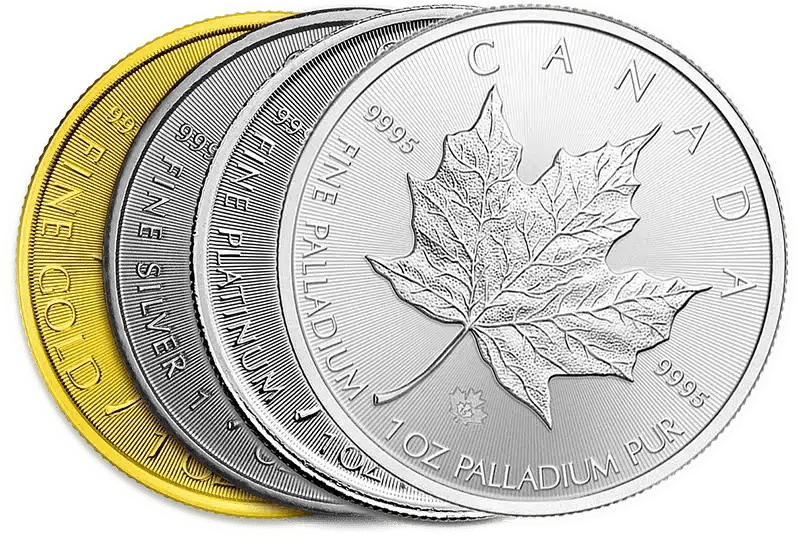
The first gold coins produced exclusively for investment purposes — rather than as legal tender — were the Krugerrand coins, introduced in the late 1960s. They spread worldwide during the gold investment boom of the 1970s, and then, during the anti-apartheid embargo, further national coins entered the market: the US with the Gold Eagle and Canada with the Maple Leaf. Gold bars struck by Swiss refineries since the 1970s quickly became popular too, and today the majority of investment gold turnover consists of bars and small bars.
Since Hungary joined the EU, investment gold bars and coins can be purchased VAT-free and can subsequently be easily converted to cash at any local gold dealer anywhere in the world.
The advantage of investment gold is that it can simply be picked up and taken along if you wish to move your assets. This can equally be a disadvantage if it falls into the wrong hands — which is precisely why insured storage services for investment gold are so sought after.
Gold Account Savings
A physically backed gold account is one of the most modern options for physical gold investment, and offers more favourable trading costs compared with purchasing investment gold outright — particularly for regular savers investing smaller amounts, such as those on average wages or young professionals just starting out.
We launched our online gold account service, Goldtresor (whose blog you are now reading), in 2018, combining our classic investment gold trading, storage and home delivery service with the convenience of regular online savings.
Goldtresor gold account registration takes just a few minutes, is completely free and carries no obligations.
Browse our account packages and choose the one that suits you best:
Start today