The Superlatives: The World's Best, Most Renowned, and Largest Gold Bars
Which types of gold bars command the highest buyback prices, and where? How much do the world's largest gold bars weigh? Curious about which gold bars lead the market in Hungary? We have gathered the answers to these questions in this article.
Goldtresor Team
· 5 min read
Which types of gold bars command the highest buyback prices, and where? How much do the world's largest gold bars weigh? Curious about which gold bars lead the market in Hungary? We have gathered the answers to these questions in this article.
CENTRAL EUROPE'S LEADING GOLD BAR MANUFACTURERS
In Central Europe, including Hungary, Swiss and German manufacturers hold the largest market share in the investment gold bar segment. The town of Mendrisio in the foothills of the Swiss Alps is home to one of the world's largest gold bar manufacturers: the Argor-Heraeus plant.
Also in the Italian-speaking part of Switzerland are the headquarters of two other globally renowned gold refineries: Pamp and Valcambi. On the European market, gold bars from Heraeus (Germany) and Umicore (Belgium and Germany) are also considered market leaders.
WHICH IS HUNGARY'S MOST SOUGHT-AFTER GOLD BAR?
In Hungary — and in Austria as well — Münze Österreich gold bars are the market-leading product. This is attributable to the characteristics of the Austrian gold market and the proximity of Vienna and Budapest. A few large banks, backed by the Austrian central bank, play a dominant role in the Austrian gold market. Münze Österreich gold wafers and bars can be purchased and sold at most bank branches.
Münze Österreich is one of Europe's oldest mints, a subsidiary of the Austrian central bank, and the producer of the world-renowned Vienna Philharmonic investment gold coins. However, the Austrian Mint does not manufacture gold bars itself, and instead has its own-brand bars produced by the Swiss firm Argor-Heraeus. Münze Österreich gold wafers and bars also bear the Argor logo, making them practically identical aside from the design — they are produced on the same manufacturing line as Argor's own products.
The parent company Heraeus also produces gold wafers and bars through its subsidiary Argor. In the 2 to 100-gram weight range, the differences between the wafers are almost entirely limited to the packaging colour.
One important distinction is that while Argor and Heraeus bars come with a factory-issued certificate, Münze Österreich gold bars above 250 grams do not include such documentation. As a result, the buying, selling, and storage of Münze Österreich gold bars is somewhat more straightforward.
WHICH GOLD BAR IS THE BEST?
The answer varies by region. At present, Münze Österreich bars command a slightly higher secondary market price in the Central European region compared with the other two competitors — albeit by only a few basis points. The reverse is also true: an investor wishing to sell a gold bar overseas or in Switzerland, for example, would likely receive a somewhat higher price for an Argor bar, while in Germany the highest consideration could probably be obtained for a Heraeus bar.
In Europe, the products of the Swiss manufacturers Valcambi, Metalor, and Pamp, as well as Belgium's Umicore, are also among the most popular beyond the manufacturers already mentioned. In the US and Canada, Asahi and the Royal Canadian Mint are the most sought-after, while in Australia it is the Perth Mint bar. Unlike investment gold coins, the gold bar market is characterised by a degree of regionality — American manufacturers, for instance, find it difficult to break into the European market. Swiss manufacturers enjoy the greatest global recognition and are present even in Far Eastern markets.
In Budapest, every gold dealer buys and sells Argor and Münze Österreich bars. Heraeus bars are available from fewer dealers in the Hungarian capital. Anyone planning to sell their gold bar in Budapest, Vienna, or perhaps Bratislava should consider investing in a Münze Österreich bar. That said, the gold price moves more in a single day than the few basis point (premium) difference between bar types.
HOW HEAVY ARE THE WORLD'S LARGEST GOLD BARS?
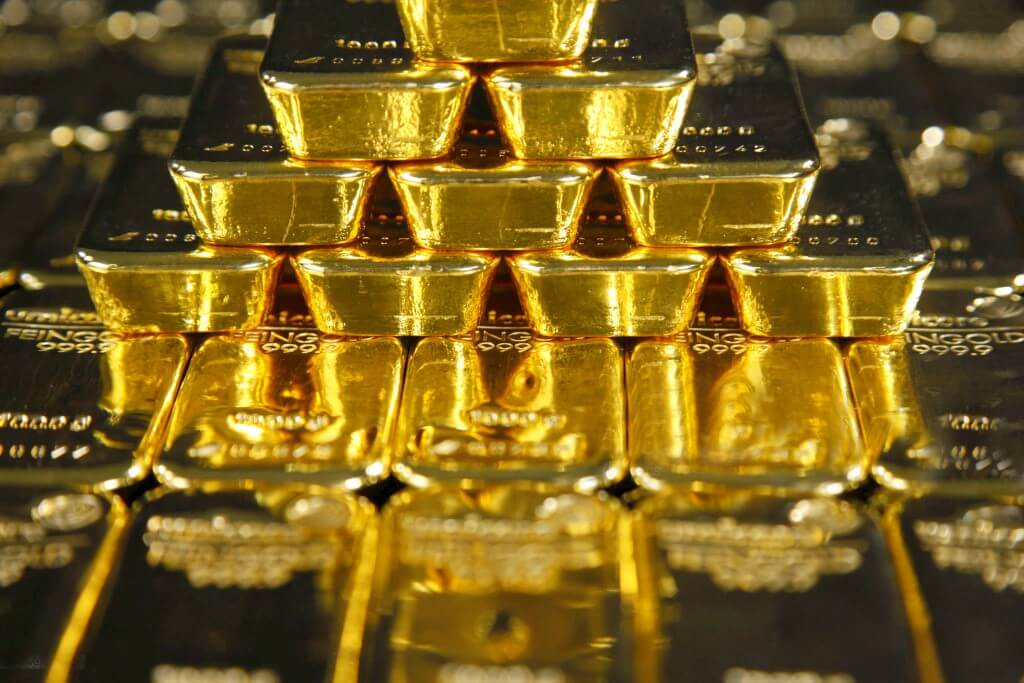
How much do those gold bricks we typically see only in films actually weigh? These are bars averaging 12.5 kg, produced according to the Good Delivery standard, and each must be weighed individually and stored with an accompanying weight list specifying its fine gold content.
The term "Good Delivery gold bar" refers concisely to a bar of deliverable quality. The LBMA determines which manufacturers' bars may be delivered to the London precious metals market. Delivery most commonly takes the form of 400-ounce gold bars. 400 troy ounces equals 12,441 grams. Manufacturers on the Good Delivery list are continuously monitored by the LBMA. Strict dimensional and quality standards apply to manufactured bars. The Good Delivery list is also known as the Gold List — in other words, it is a list of manufacturers with the right to deliver to the London precious metals market.
The Good Delivery standard defines fairly wide boundaries (350 to 430 ounces) for the largest gold bars, yet around 400 ounces is by far the most common size among manufacturers. These bars are rarely transported out of vaults and are generally purchased only by large investors and central banks.
400-ounce Good Delivery bars are also typically stored in London or other major gold centres as collateral for gold account settlements and gold loans between wholesalers, refineries, and central banks. Within the Goldtresor system, however, for practical reasons, 1,000-gram gold bars predominantly serve as collateral for the gold account balances of clients.
THE MOST DISTINCTIVE GOLD BARS: A FEW CURIOSITIES
Finally, we would like to highlight some exceptional gold bars with non-standard weights or shapes. Certain countries also cast 100-ounce (3,110.3 gram) gold bars, and bars cast in other units of measurement also exist — for example, bars expressed in the tola weight unit (11.6639 grams) that has been in use in India and Nepal since ancient times, or bars measured in the Chinese tael unit, which weighs 37.5 grams.
Distinctive gold bars and gold bar collections can be encountered in China on the occasion of the Chinese New Year: boat-shaped Chinese gold ingots (yuanbao) have been popular since the Qing dynasty and are still purchased today as festive gifts.
Since gold bars have been cast for thousands of years, there are collections specialising in historic and industrial gold bars, such as the famous Rothschild gold bar collection.
Start today