Knowledge Base & FAQ · Chapter 21
The Gold Production Process - Gold Mining, Ore Processing and Gold Extraction from Ore
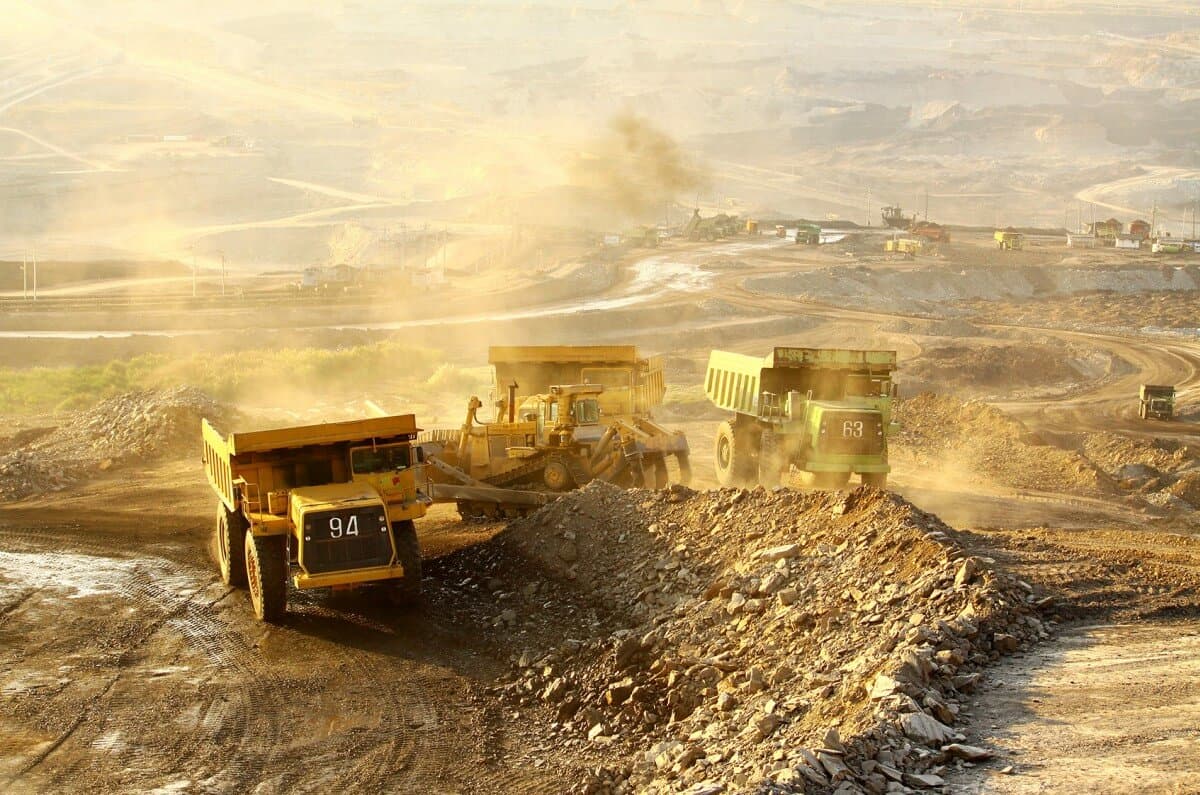
Gold mine operational area with mining trucks and heavy machinery, showing the ore extraction process from a bird's eye view on a dusty, sun-drenched landscape.
Gold production is an exceptionally complex and fascinating process, beginning with the opening of a mine, followed by extraction and finally refining.
Preparing to Open a Mine
Opening a mine begins with a geological survey of the area in question, searching for signs of gold deposits. Field geologists examine the rocks present on the surface and compile a regional geological map. The next step in the mine-opening process is to carry out geophysical and geochemical surveys in areas that appear promising. Geophysical surveys can penetrate below the surface and generate a three-dimensional map. However, validation drilling must be performed to determine the extent of underground ore bodies and their metal content. The initial costs of preparing and investing in a gold mining operation typically take many years to recoup. As a general rule, one can safely count on 5 to 10 years, though this naturally depends on many individual factors and the specific characteristics of the mine.
If the outlook remains positive after evaluating the drilling results and it appears worthwhile to open a gold mine in the area under consideration, a feasibility study can be prepared. This requires further, more precise drilling so that the three-dimensional ore body revealed by the drill data can be finalised, producing an underground gold occurrence map and enabling the calculations necessary for the mine plan.
An environmental and social impact assessment must then be conducted, and a dialogue involving local leaders and the area's residents must take place. At this point the mining permit application can be submitted, which also includes a rehabilitation plan. Once the mining permit has been granted, extraction can begin.
The Start of Effective Gold Mining
Extraction and Blasting Plan
The film shown at the end of this chapter presents an open-pit mine where the blasting technicians place explosives into the boreholes, and, following a siren signal, execute a chain blast. Only one block is blasted at a time. The extraction and blasting plan is developed on the basis of laboratory measurements. The rock to be blasted is classified into blocks according to the ore's precious metal content and chemical characteristics (for example, whether the rock also contains sulphides).
The extracted rocks are sorted according to their ore content into waste rock for stockpiling, low-grade ore and higher-grade ore.
The extraction plan may also be influenced by the gold price, since if the gold price falls below the level of extraction costs, it is temporarily not worthwhile to process low-grade rock. In such cases, extraction is concentrated on the best areas of the mine while other areas are left idle, or the lower-grade rock is stockpiled for later processing.
Rock Handling
Lower-grade rocks are treated by cyanide heap leaching, and the percolating liquid, which dissolves the gold cyanide into a complex solution, is collected in surface ponds (this method is no longer permitted everywhere) prior to further processing. The solution is then loaded with carbon, which binds the gold cyanide particles, after which the next processing phase can begin.
Ore Processing
High-grade rocks are taken directly to the grinding mill and subjected to (closed-circuit) cyanide treatment to dissolve the precious metal into solution in the form of a gold cyanide complex. If the ore has a high sulphide content, it is first wet-ground, then roasted in an autoclave so that the high pressure and oxidative heating release the gold from the sulphide bonds. This pre-treatment precedes the cyanide process.
Concentration and Separation
Finally, all previous processes converge during further processing. The liquid, high-grade precious metal slurry is concentrated in a centrifuge. At this stage the gold cyanide particles are still attached to carbon particles. The final step is to transfer the gold into an electrolyte solution and to recover the gold and silver on a mesh placed at the cathode.
The Dore Bar Is Produced
The mine's end product, the so-called dore bar, is then cast in the mining company's smelter. A dore bar contains approximately 85% gold and 15% silver and other materials. The dore bars are sent to European refineries, which then separate and refine the metals contained in the bars. When a mine is exhausted, rehabilitation follows. The lifecycle of gold mining comes full circle once rehabilitation begins.
Goldtresor Online Precious Metals Trading Platform
Did you know that buying and selling gold and silver is easy, fast and secure with us?
You decide whether to trade online or collect your investment gold and silver from us in physical form. It is your choice, depending on your strategy at any given time.
What is more, you can also hold and trade platinum and palladium, even from the comfort of your sofa, 24 hours a day.
Feel free to contact our professional and friendly team by email: support@goldtresor.com.
Find the details here:
Newmont's Nevada Mine (Video)
The detailed short film below was made at the Nevada mine of one of the world's largest gold mining companies (Newmont) and vividly presents the opening of a gold mine, its operation, ore processing and the casting of dore bars (the end product that leaves the mine). The processes and methods used are optimised for the particular mine and ore deposit, so a different mine might employ somewhat different processing techniques.
We hope our overview has helped you gain a better understanding of the key stages of gold mining. On our website you will find many other interesting articles and current updates from the world of investment precious metals. If you cannot find the answer to a question, or would like to become an investor client and trade precious metals efficiently, whether online or in person, please do not hesitate to contact us!
Further information on gold mining on Wikipedia.