Security & Storage · Chapter 16
Identifying Counterfeit Gold. Gold Counterfeiting Methods
Ultrasonic gold bar testing device in operation, providing precise data on the authenticity and quality of gold bars in a warehouse environment.
How to detect counterfeit gold, how bullion dealers verify investment gold bars and coins, and what warning signs should you watch for?
Is there counterfeit gold in circulation?
Like all valuable commodities, gold is counterfeited. Nevertheless, there is probably far less counterfeit gold in circulation overall than counterfeit currency. This is because professional bullion dealers employ instruments and testing methods that can conclusively identify forgeries. For this reason, it is essential to purchase gold from a reputable source.
Cheap gold?
If you search for terms such as "fake gold" or "counterfeit gold," you will immediately encounter advertisements offering what appears to be a 10-gram gold wafer (worth approximately 450 dollars) for just a few dollars.
How is gold counterfeited?
In the past, gold was counterfeited using copper alloys; more recently, tungsten cores concealed inside bars have become the preferred method. Copper is easily detected through weighing and volume measurement owing to its different specific gravity, whereas identifying a tungsten core requires specialised instruments (ultrasonic testing or a magnetic balance). Because tungsten has the same density as gold, conventional density-measuring instruments cannot be used.
How can I verify that the gold I purchased is genuine?
If you buy gold from a reputable source, the likelihood of encountering a counterfeit is very low. You may request a non-destructive test from a bullion dealer you trust. If any doubt remains, a destructive test must be performed. This can involve drilling into the gold bar, or, as the most drastic measure, melting it down. In Hungary, official assaying is carried out by NEHITI through destructive testing, though numerous other firms also perform smelting. A bullion dealer can assist with this as well.
Non-destructive gold bar and coin testing: the ultrasonic method
The propagation speed of ultrasound in pure gold is approximately 3,200 m/sec, compared to 5,500-6,000 m/sec in tungsten. A key property of ultrasound is that it reflects off solid bodies. If the instrument is calibrated to the speed characteristic of gold, for example 3,240 m/sec, the ultrasound wave reflected from the far side of the bar can be used to measure its thickness. At room temperature, this reading should match the thickness measured with callipers.
Non-destructive gold bar and coin testing: authenticity verification with a magnetic balance
If the ultrasonic reading is lower than the calliper measurement, the bar contains a solid core that does not alloy with gold. This is likely a tungsten core, and in such cases it is advisable to drill the bar deeply or to melt it down. Tungsten does not alloy with gold because gold's boiling point is 2,970 degrees C, while tungsten's melting point is 3,422 degrees C. If, on the other hand, gold is alloyed with copper, a 1-kilogram alloy bar can be as much as 40-50% larger than a standard 1 kg fine gold bar, since copper's density is considerably lower than that of gold.
For testing Good Delivery-size gold bars, higher-powered ultrasonic equipment is used, which can display internal inclusions and encased tungsten cores on a screen.
The traditional method of drilling gold bars, typically used for taking material samples, is unsuitable for detecting tungsten-filled bars because it penetrates only approximately 1-2 mm, and counterfeiters typically cast several millimetres of gold around the tungsten core.
Non-destructive gold bar and coin testing: authenticity verification with a magnetic balance
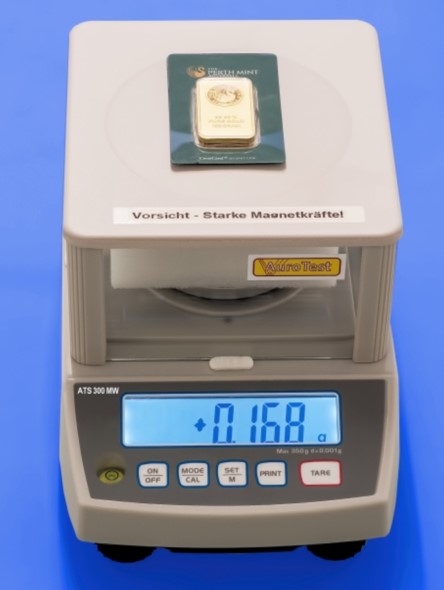
A more recent non-destructive method for detecting counterfeit gold is the magnetic balance. This technique is based on the differing magnetic properties of pure gold and tungsten. Gold is slightly diamagnetic (it repels a magnet), whereas tungsten is paramagnetic and therefore attracts a magnet. The magnetic balance is a scale with a powerful magnet mounted on top, zeroed (tared) with the magnet in place. When a gold bar or coin is placed above the strong magnetic field, it slightly repels the magnet, causing it to press down on the scale and display a low positive value. Each product has a characteristic measurement range, and dealers compare the result against purpose-built reference tables. If the product contains impurities or a paramagnetic inclusion (such as tungsten), the sample will pull the magnet towards itself. This method is less reliable with alloys.
Do gold bars need to be hallmarked?
Within the European Union, products from accredited-list manufacturers do not require a separate hallmark. Given the above, hallmarking gold bars would be pointless, as counterfeiters could just as easily forge the hallmark onto the bars.